K-means clustering (unsupervised learning algorithm)
An unsupervised machine learning technique called K-Means Clustering assists in assembling data points into clusters according to their innate similarity.K-Mean is utilized when we have unlabeled data and the objective is to find hidden patterns or structures, as opposed to supervised learning, where models are trained using labeled data.
An online retailer, for instance, can divide its clientele into groups like ""Big Spenders," "Frequent Buyers," and "Budget Shoppers" according to their past purchases
"k" stands for the number of clusters or groups into which we wish to divide our objects.
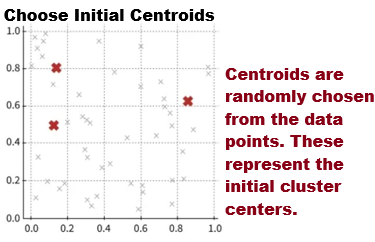
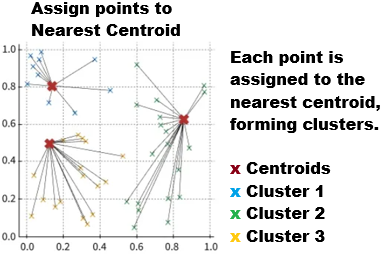
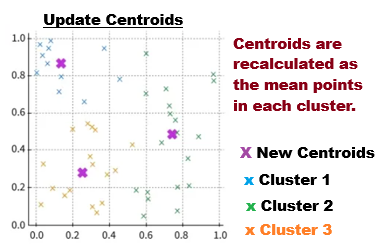
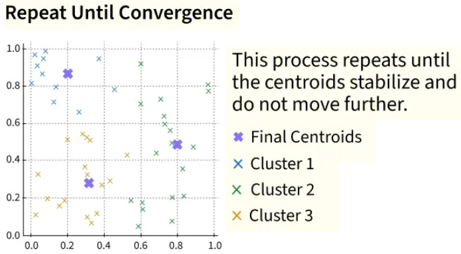
Let's see an example with a sample data..
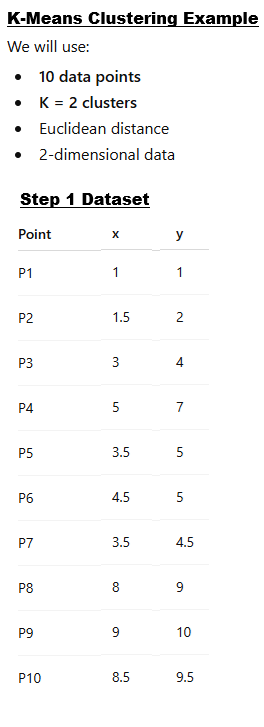
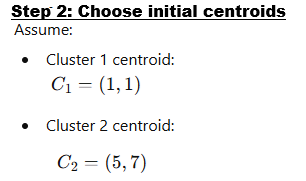
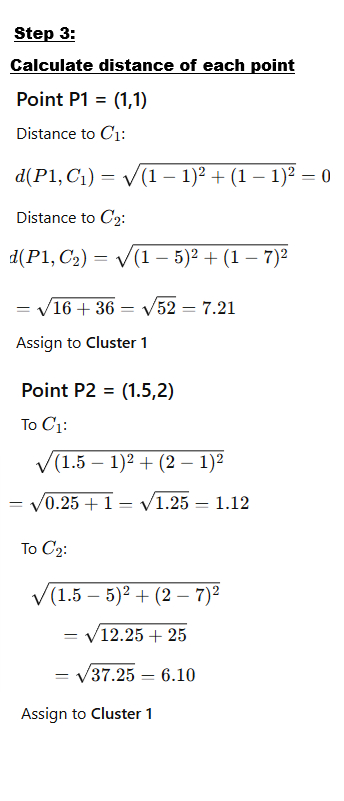
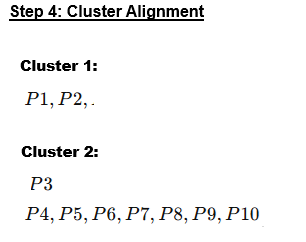
K-Means Customer Segmentation
Complete step-by-step calculation using 10 customers, 4 independent variables, and K = 3 clusters.
1. Customer Data
We use four independent variables:
- Annual Income — represented in $10,000s
- Annual Spending — represented in $1,000s
- Number of Purchases
- Customer Engagement Score — 1 to 10
| Customer | Income | Spending | Purchases | Engagement |
|---|---|---|---|---|
| C1 | 2 | 2 | 2 | 2 |
| C2 | 3 | 2 | 2 | 3 |
| C3 | 2 | 3 | 2 | 2 |
| C4 | 3 | 3 | 3 | 3 |
| C5 | 7 | 7 | 7 | 7 |
| C6 | 8 | 7 | 8 | 7 |
| C7 | 7 | 8 | 7 | 8 |
| C8 | 8 | 8 | 8 | 8 |
| C9 | 4 | 9 | 4 | 9 |
| C10 | 5 | 8 | 5 | 9 |
Each customer is represented as:
For example:
2. Choose the Number of Clusters
For this example:
The three groups will eventually be interpreted as:
- Low-value customers
- High-value customers
- High-spending / highly engaged customers
3. Select Initial Centroids
We choose C1, C5, and C9 as the initial centroids.
Centroid 1
Centroid 2
Centroid 3
4. Euclidean Distance Formula
Because there are four independent variables, the distance between a customer and a centroid is:
Example: C2 → Centroid 1
C2 = (3, 2, 2, 3), and M₁ = (2, 2, 2, 2).
= √[1² + 0² + 0² + 1²]
= √2
= 1.414
C2 → Centroid 2
= √[16 + 25 + 25 + 16]
= √82
= 9.055
C2 → Centroid 3
= √[1 + 49 + 4 + 36]
= √90
= 9.487
5. Iteration 1 — Calculate All Distances
| Customer | Distance to M₁ | Distance to M₂ | Distance to M₃ | Assigned Cluster |
|---|---|---|---|---|
| C1 | 0.000 | 10.000 | 10.296 | 1 |
| C2 | 1.414 | 9.055 | 9.487 | 1 |
| C3 | 1.000 | 9.539 | 9.644 | 1 |
| C4 | 2.000 | 8.000 | 8.602 | 1 |
| C5 | 10.000 | 0.000 | 5.099 | 2 |
| C6 | 11.045 | 1.414 | 6.325 | 2 |
| C7 | 11.045 | 1.414 | 4.472 | 2 |
| C8 | 12.000 | 2.000 | 5.831 | 2 |
| C9 | 10.296 | 5.099 | 0.000 | 3 |
| C10 | 10.149 | 3.606 | 1.732 | 3 |
Cluster 1
C1, C2, C3, C4
Cluster 2
C5, C6, C7, C8
Cluster 3
C9, C10
6. Calculate the New Centroid — Cluster 1
| Customer | Income | Spending | Purchases | Engagement |
|---|---|---|---|---|
| C1 | 2 | 2 | 2 | 2 |
| C2 | 3 | 2 | 2 | 3 |
| C3 | 2 | 3 | 2 | 2 |
| C4 | 3 | 3 | 3 | 3 |
Spending = (2+2+3+3)/4 = 10/4 = 2.50
Purchases = (2+2+2+3)/4 = 9/4 = 2.25
Engagement = (2+3+2+3)/4 = 10/4 = 2.50
7. Calculate the New Centroid — Cluster 2
| Customer | Income | Spending | Purchases | Engagement |
|---|---|---|---|---|
| C5 | 7 | 7 | 7 | 7 |
| C6 | 8 | 7 | 8 | 7 |
| C7 | 7 | 8 | 7 | 8 |
| C8 | 8 | 8 | 8 | 8 |
Spending = (7+7+8+8)/4 = 7.50
Purchases = (7+8+7+8)/4 = 7.50
Engagement = (7+7+8+8)/4 = 7.50
8. Calculate the New Centroid — Cluster 3
| Customer | Income | Spending | Purchases | Engagement |
|---|---|---|---|---|
| C9 | 4 | 9 | 4 | 9 |
| C10 | 5 | 8 | 5 | 9 |
Spending = (9+8)/2 = 8.50
Purchases = (4+5)/2 = 4.50
Engagement = (9+9)/2 = 9.00
9. New Centroids After Iteration 1
| Cluster | Income | Spending | Purchases | Engagement |
|---|---|---|---|---|
| Cluster 1 | 2.50 | 2.50 | 2.25 | 2.50 |
| Cluster 2 | 7.50 | 7.50 | 7.50 | 7.50 |
| Cluster 3 | 4.50 | 8.50 | 4.50 | 9.00 |
10. Iteration 2 — Recalculate Distances
Using the new centroids, we calculate the distances again.
Example: C1 → New M₁
M₁ = (2.5,2.5,2.25,2.5)
d = √[(2-2.5)² + (2-2.5)² + (2-2.25)² + (2-2.5)²]
= √[0.25 + 0.25 + 0.0625 + 0.25]
= √0.8125
= 0.901
C1 → New M₂
= √121
= 11.000
C1 → New M₃
= √103.75
= 10.186
11. Iteration 2 — All Distances
| Customer | To M₁ | To M₂ | To M₃ | Cluster |
|---|---|---|---|---|
| C1 | 0.901 | 11.000 | 10.186 | 1 |
| C2 | 0.901 | 10.050 | 9.314 | 1 |
| C3 | 0.901 | 10.536 | 9.579 | 1 |
| C4 | 1.146 | 9.000 | 8.411 | 1 |
| C5 | 9.128 | 1.000 | 4.330 | 2 |
| C6 | 10.189 | 1.000 | 5.545 | 2 |
| C7 | 10.164 | 1.000 | 3.708 | 2 |
| C8 | 11.127 | 1.000 | 5.074 | 2 |
| C9 | 9.477 | 5.385 | 0.866 | 3 |
| C10 | 9.290 | 3.873 | 0.866 | 3 |
12. Final Customer Segmentation
Cluster 1 — Low-Value Customers
C1, C2, C3, C4
Centroid: (2.50, 2.50, 2.25, 2.50)
- Low income
- Low spending
- Few purchases
- Low engagement
Possible strategies: discounts, introductory offers, loyalty programs, cross-selling, and engagement campaigns.
Cluster 2 — High-Value Customers
C5, C6, C7, C8
Centroid: (7.50, 7.50, 7.50, 7.50)
- High income
- High spending
- Frequent purchases
- High engagement
Possible strategies: VIP programs, premium products, exclusive offers, early access, and personalized recommendations.
Cluster 3 — High-Spending / Highly Engaged
C9, C10
Centroid: (4.50, 8.50, 4.50, 9.00)
- Moderate income
- Very high spending
- Moderate purchase frequency
- Very high engagement
Possible strategies: premium products, upselling, personalized marketing, subscriptions, and loyalty rewards.
13. Final Results
| Customer | Income | Spending | Purchases | Engagement | Final Cluster |
|---|---|---|---|---|---|
| C1 | 2 | 2 | 2 | 2 | 1 |
| C2 | 3 | 2 | 2 | 3 | 1 |
| C3 | 2 | 3 | 2 | 2 | 1 |
| C4 | 3 | 3 | 3 | 3 | 1 |
| C5 | 7 | 7 | 7 | 7 | 2 |
| C6 | 8 | 7 | 8 | 7 | 2 |
| C7 | 7 | 8 | 7 | 8 | 2 |
| C8 | 8 | 8 | 8 | 8 | 2 |
| C9 | 4 | 9 | 4 | 9 | 3 |
| C10 | 5 | 8 | 5 | 9 | 3 |
14. Complete K-Means Mathematical Summary
Step 1 — Data Matrix
(2,2,2,2), (3,2,2,3), (2,3,2,2), (3,3,3,3),
(7,7,7,7), (8,7,8,7), (7,8,7,8), (8,8,8,8),
(4,9,4,9), (5,8,5,9)
]
Step 2 — Choose K
Step 3 — Initial Centroids
M₂ = (7,7,7,7)
M₃ = (4,9,4,9)
Step 4 — Distance Calculation
Step 5 — Cluster Assignment
Step 6 — Recalculate Centroids
Step 7 — Repeat
Repeat the distance and centroid calculations until the cluster assignments no longer change.
15. Business Interpretation
| Cluster | Customers | Segment | Business Value |
|---|---|---|---|
| 1 | C1–C4 | Low-value / low engagement | Need nurturing |
| 2 | C5–C8 | High-value / loyal | Highest priority |
| 3 | C9–C10 | High spending / highly engaged | Strong upsell opportunity |
USE CASE 1: Healthcare Patient Grouping using K-Means Clustering: Hospitals often need to group patients with similar characteristics to: Identify high-risk patients, Personalize treatment plans, Optimize resource allocation, Improve healthcare management