|
PythonPlaza -
Python & AI
|
Supervised Machine Learning Algorithms
Decision Trees (Classification Algorithm)
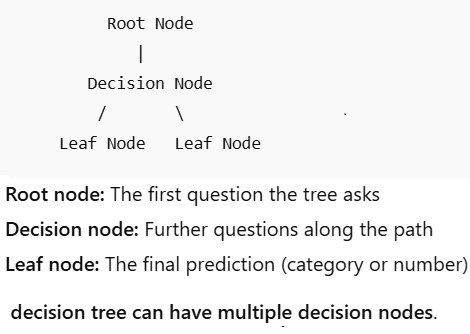
The decision tree is called that because it creates models for classification or prediction in the shape of a tree. It splits the data into smaller parts and connects each part with a decision. This makes a tree with decision points and final answers. A decision point can have two or more paths and leads to the final answers. A final answer shows the result of the classification or decision. It uses the if-then-else rule to make predictions. As you go deeper into the tree, the rules get more complicated, which makes the model more accurate. A decision tree has:
Root Node: The process starts at the top of the tree with the entire dataset.
Internal Nodes (Decision Nodes): At each internal node, the algorithm tests a specific attribute or feature to split the data into smaller, more homogeneous subsets.
Leaf Nodes (Terminal Nodes): The process ends at the leaf nodes, which represent the final decision, class label, or predicted continuous value.
Let's see an example
Decision Tree Regression
Complete House Price Prediction Example
10 houses • 3 independent variables • MSE-based splitting
1. Sample Housing Data
| House | Size (sq ft) | Bedrooms | Age (years) | Price ($000s) |
|---|
| 1 | 1,000 | 2 | 30 | 220 |
| 2 | 1,200 | 2 | 20 | 250 |
| 3 | 1,400 | 3 | 15 | 290 |
| 4 | 1,500 | 3 | 10 | 320 |
| 5 | 1,600 | 3 | 8 | 350 |
| 6 | 1,800 | 3 | 5 | 300 |
| 7 | 2,000 | 4 | 10 | 390 |
| 8 | 2,200 | 4 | 5 | 430 |
| 9 | 2,400 | 4 | 3 | 470 |
| 10 | 2,600 | 5 | 2 | 510 |
Inputs: Size, Bedrooms, Age | Target: Price
2. What Does a Regression Tree Minimize?
The tree wants each resulting group to contain prices that are as close as possible to that group's mean.
MSE = (1/n) Σ(Yᵢ − Ȳ)²
For a candidate split:
Weighted MSE = (NL/N)MSEL + (NR/N)MSER
Split-selection rule: choose the feature and threshold with the lowest weighted MSE.
3. Root Node
Initially all 10 houses are together.
Ȳ = (220 + 250 + 290 + 320 + 350 + 300 + 390 + 430 + 470 + 510) / 10 = 353
So the root predicts $353,000.
| House | Y | Mean | Error | Error² |
|---|
| 1 | 220 | 353 | -133 | 17,689 |
| 2 | 250 | 353 | -103 | 10,609 |
| 3 | 290 | 353 | -63 | 3,969 |
| 4 | 320 | 353 | -33 | 1,089 |
| 5 | 350 | 353 | -3 | 9 |
| 6 | 300 | 353 | -53 | 2,809 |
| 7 | 390 | 353 | 37 | 1,369 |
| 8 | 430 | 353 | 77 | 5,929 |
| 9 | 470 | 353 | 117 | 13,689 |
| 10 | 510 | 353 | 157 | 24,649 |
ΣError² = 81,800 → MSEroot = 81,800/10 = 8,180
4. Example: Test Size ≤ 1,750
Size ≤ 1,750 sq ft?
YES
Houses 1–5
220, 250, 290, 320, 350
NO
Houses 6–10
300, 390, 430, 470, 510
Left group
Mean = 1430/5 = 286
Σ(Y−286)² = 10,920
MSEL = 10,920/5 = 2,184
Right group
Mean = 2100/5 = 420
Σ(Y−420)² = 26,000
MSER = 26,000/5 = 5,200
Weighted MSE = (5/10)(2,184) + (5/10)(5,200) = 3,692
MSE falls from 8,180 to 3,692. This is a good split, but the tree keeps searching.
5. Test Many Size Thresholds
| Candidate split | Weighted MSE |
|---|
| Size ≤ 1,100 | 6,956.76 |
| Size ≤ 1,300 | 5,044.44 |
| Size ≤ 1,450 | 4,085.71 |
| Size ≤ 1,550 | 3,530.00 |
| Size ≤ 1,750 | 3,692.00 |
| Size ≤ 1,900 | 4,420.00 |
| Size ≤ 2,100 | 4,260.00 |
| Size ≤ 2,300 | 3,652.22 |
| Size ≤ 2,500 | 3,278.89 ★ LOWEST |
The first important lesson is that the tree does not simply choose the first split that improves MSE. It searches the candidate thresholds and selects the lowest one.
6. Compare Size, Bedrooms and Age
| Feature | Best threshold | Lowest weighted MSE |
|---|
| Size | ≤ 2,500 sq ft | 3,278.89 |
| Bedrooms | ≤ 3 | 4,050.00 |
| Age | ≤ 4 years | 5,120.00 |
Winner: Size ≤ 2,500, because 3,278.89 is the smallest weighted MSE.
7. First Decision Tree
Size ≤ 2,500 sq ft?
YES
Houses 1–9
Prediction = 335.56
NO
House 10
Prediction = 510
Left prediction = (220+250+290+320+350+300+390+430+470)/9 = 3020/9 = 335.56
Right prediction = 510/1 = 510
Thus this tree predicts approximately $335,560 for Houses 1–9 and $510,000 for House 10.
8. What the Algorithm Does at Every Node
Step 1: Pick a feature.
Step 2: Try a threshold.
Step 3: Divide observations into left and right groups.
Step 4: Calculate each group's mean.
Step 5: Calculate each group's MSE.
Step 6: Calculate weighted MSE.
Step 7: Repeat for all candidate feature/threshold combinations.
Step 8: Choose the split with the lowest weighted MSE.
9. Connection to Gradient Boosting Regression
If this tree is being used inside gradient boosting, the next trees learn from the errors left by the previous model.
F₀ = mean(Y)
rᵢ = Yᵢ − Ft−1(xᵢ)
Fit a decision tree to the residuals
γleaf = Σrᵢ / Nleaf
Ft(x) = Ft−1(x) + ηγleaf
Key distinction: an ordinary Decision Tree Regressor predicts the original prices. In Gradient Boosting Regression, later trees are fitted to residuals. In either case, MSE can be used to choose the best split for a regression tree.
10. Main Idea
A regression decision tree tries many feature/threshold combinations and chooses the one that produces the lowest weighted MSE. A low MSE means the observations inside the resulting groups have prices that are close to their group means.
Decision Tree Regression • Housing Price Worked Example • MSE-Based Splitting
USE CASE 1: Using Decision Tree with scikit-learn, predict the product price. The Production cost, Advertising spend, and Demand level are the independent variables.
import pandas as pd
from sklearn.tree import DecisionTreeRegressor
from sklearn.model_selection import train_test_split
from sklearn.metrics import mean_absolute_error, r2_score

# -----------------------------------
# 1. Load data from Excel
# -----------------------------------
data = pd.read_excel("product_data.xlsx")

print("Dataset Preview:")
print(data.head())

# -----------------------------------
# 2. Define features and target
# -----------------------------------
X = data[['Production_Cost', 'Advertising_Spend', 'Demand_Level']]
y = data['Product_Price']

# -----------------------------------
# 3. Split into training and testing
# -----------------------------------
X_train, X_test, y_train, y_test = train_test_split(
    X, y, test_size=0.25, random_state=42
)

# -----------------------------------
# 4. Train the Decision Tree model
# -----------------------------------
model = DecisionTreeRegressor(
    max_depth=4,
    random_state=42
)


## What is random_state?

#train_test_split randomly shuffles the dataset before splitting.
#Without random_state:
#Each run → different split
#Model performance changes slightly
#With random_state=42:
#Same rows go to train/test every time
#Results are reproducible


model.fit(X_train, y_train)


# -----------------------------------
# 6. Evaluate the model
# -----------------------------------
y_pred = model.predict(X_test)

print("MAE:", mean_absolute_error(y_test, y_pred))
print("R² score:", r2_score(y_test, y_pred))


# -----------------------------------
# 7. Predict price for a new product
# -----------------------------------
new_product = pd.DataFrame({
    'Production_Cost': [68],
    'Advertising_Spend': [13],
    'Demand_Level': [37]
})

predicted_price = model.predict(new_product)

print("\nPredicted Product Price:", predicted_price[0])
USE CASE 2: Using Decision Tree with scikit-learn to predict the Student Grade. The 'Hours_Studied, 'Attendance_%', 'Previous_Score' are the independent variables.
import numpy as np
from sklearn.model_selection import train_test_split
from sklearn.tree import DecisionTreeRegressor
from sklearn.metrics import mean_absolute_error, r2_score

# -----------------------------------
# 1. Load data from Excel
# -----------------------------------
#sample data can be exported to
#excel from the URL
# https://pythonPlaza.com/linear_school_grade_data.html

data = pd.read_excel("student_data.xlsx")

print("Dataset Preview:")
print(data.head())

# -----------------------------------
# 2. Define features and target
# -----------------------------------
X = data[['Hours_Studied', 'Attendance_%', 'Previous_Score']]
y = data['Final_Grade']

# -----------------------------------
# 3. Split into training and testing
# -----------------------------------
X_train, X_test, y_train, y_test = train_test_split(
    X, y, test_size=0.25, random_state=42
)


# -----------------------------------
# 4. Train the Decision Tree model
# -----------------------------------
model = DecisionTreeRegressor(
    max_depth=4,
    random_state=42
)


## What is random_state?

#train_test_split randomly shuffles the dataset before splitting.
#Without random_state:
#Each run → different split
#Model performance changes slightly
#With random_state=42:
#Same rows go to train/test every time
#Results are reproducible


model.fit(X_train, y_train)

# -----------------------------------
# 6. Evaluate the model
# -----------------------------------
y_pred = model.predict(X_test)

print("MAE:", mean_absolute_error(y_test, y_pred))
print("R² score:", r2_score(y_test, y_pred))


Example: Predict a new student’s grade
# New student: [hours_studied, attendance %, previous_score]
new_student = np.array([[6, 85, 78]])

predicted_grade = model.predict(new_student)
print("Predicted final grade:", predicted_grade[0])
USE CASE 3: Using Decision Tree with scikit-learn to predict the Profit Optimization. The Price (P), Advertising (A), Units Sold (Q) are the independent variables, and Profit is the dependent variable.
import numpy as np
from sklearn.model_selection import train_test_split
from sklearn.tree import DecisionTreeRegressor
from sklearn.metrics import mean_absolute_error, r2_score

# -----------------------------------
# 1. Load data from Excel
# -----------------------------------
#sample data can be exported to
#excel from the URL


  Get the Profit Optimization data in Excel


data = pd.read_excel("profit_optimization.xlsx")

print("Dataset Preview:")
print(data.head())

# -----------------------------------
# 2. Define features and target  Price (P)
# -----------------------------------
X = data[['Price', 'Advertising', 'Units_Sold']]
y = data['Profit']

# -----------------------------------
# 3. Split into training and testing
# -----------------------------------
X_train, X_test, y_train, y_test = train_test_split(
    X, y, test_size=0.25, random_state=42
)


# -----------------------------------
# 4. Train the Decision Tree model
# -----------------------------------
model = DecisionTreeRegressor(
    max_depth=4,
    random_state=42
)


## What is random_state?

#train_test_split randomly shuffles the dataset before splitting.
#Without random_state:
#Each run → different split
#Model performance changes slightly
#With random_state=42:
#Same rows go to train/test every time
#Results are reproducible


model.fit(X_train, y_train)

# -----------------------------------
# 6. Evaluate the model
# -----------------------------------
y_pred = model.predict(X_test)

print("MAE:", mean_absolute_error(y_test, y_pred))
print("R² score:", r2_score(y_test, y_pred))


#Predict profit for a new business strategy
# Example: Price = 15, Advertising = 165, Units Sold = 460
new_strategy = np.array([[15, 165, 460]])

predicted_profit = model.predict(new_strategy)
print("Predicted profit:", predicted_profit[0])
USE CASE 4: Using Decision Tree with scikit-learn to predict the Patient Response. The Dosage (mg), Age (yrs), Weight (lbs) are the independent variables, and Patient Response is the dependent variable.
import numpy as np
from sklearn.model_selection import train_test_split
from sklearn.tree import DecisionTreeRegressor
from sklearn.metrics import mean_absolute_error, r2_score

# -----------------------------------
# 1. Load data from Excel
# -----------------------------------
#sample data can be exported to
#excel from the URL


  Get the Patient Response Data in Excel


data = pd.read_excel("patient_dosage_response.xlsx")

print("Dataset Preview:")
print(data.head())

# -----------------------------------
# 2. Define features and target  Price (P)
# -----------------------------------
X = data[['Dosage', 'Age', 'Weight']]
y = data['Patient_Response']

# -----------------------------------
# 3. Split into training and testing
# -----------------------------------
X_train, X_test, y_train, y_test = train_test_split(
    X, y, test_size=0.25, random_state=42
)


# -----------------------------------
# 4. Train the Decision Tree model
# -----------------------------------
model = DecisionTreeRegressor(
    max_depth=4,
    random_state=42
)


## What is random_state?

#train_test_split randomly shuffles the dataset before splitting.
#Without random_state:
#Each run → different split
#Model performance changes slightly
#With random_state=42:
#Same rows go to train/test every time
#Results are reproducible


model.fit(X_train, y_train)


# -----------------------------------
# 6. Evaluate the model
# -----------------------------------
y_pred = model.predict(X_test)

print("MAE:", mean_absolute_error(y_test, y_pred))
print("R² score:", r2_score(y_test, y_pred))

Predict response for a new patient
# New patient: Dosage=72mg, Age=36yrs, Weight=172lbs
new_patient = np.array([[72, 36, 172]])

predicted_response = model.predict(new_patient)
print("Predicted patient response:", predicted_response[0])
About Us | Contact Us | Sitemap | Privacy Policy